
Culture
the application form •
The publisher of Settecolori does not endorse the ‘Più libri più liberi’ initiative and explains why. The letter
Manuel Grillo has not signed the anti-fascism clause required by the AIE to take part in the Rome book fair. This is not a departure from the Constitution, he says, but a conviction that respecting it is sufficient to participate legitimately. His catalogue also stands in his defence: from Rebatet to Weiss
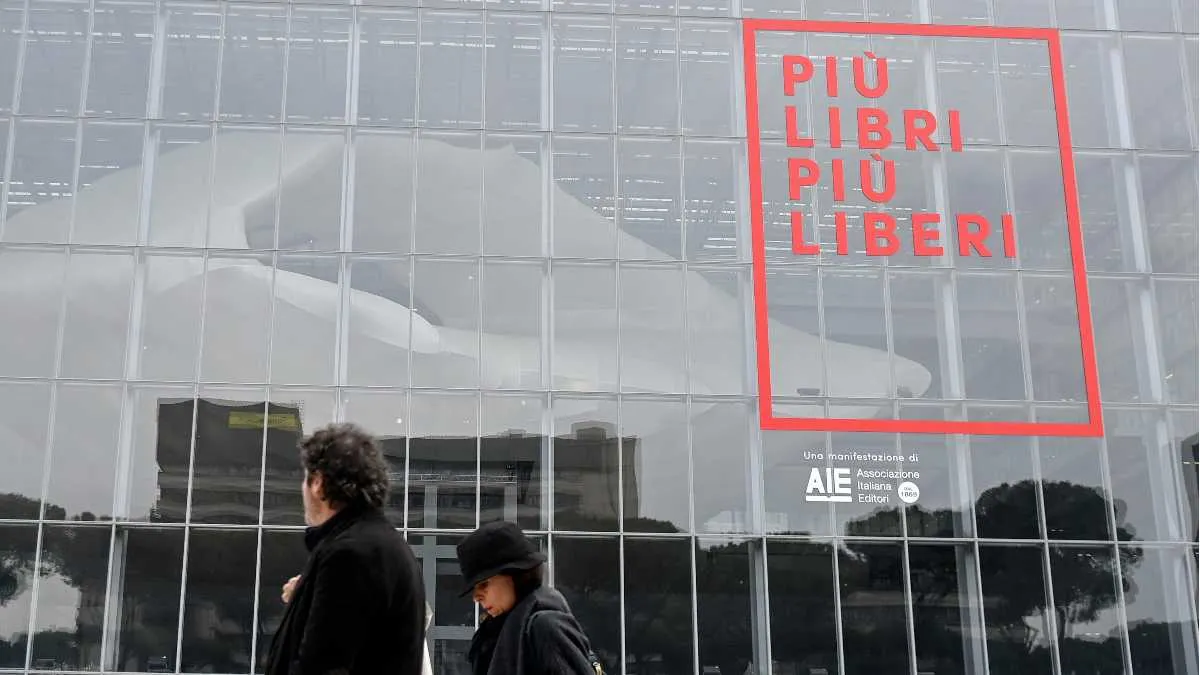
The 2024 edition of the national small and medium-sized publishers’ fair “Più libri più liberi”, held at the Nuvola in Rome’s EUR district (Ansa/Riccardo Antimiani)
Manuel Grillo is the sole director of Edizioni Settecolori – I Due Stendardi S.r.l., a small independent publishing house based in Milan, founded in 2023 and now one of the most popular names on the Italian publishing scene. A member of the Italian Publishers’ Association, Grillo has submitted Settecolori’s application to take part in ‘Più libri più liberi 2026’, scheduled to take place in Rome this coming December, specifying that he has not signed the clause in the application form requiring publishers to make a declaration of anti-fascism as a condition of admission to the event. He emphasises that this decision does not represent any distancing from the Constitution or the democratic system: on the contrary, it stems from the conviction that respect for the Constitution and the laws of the Republic constitutes a necessary and sufficient prerequisite for participation in a cultural and professional event, without the need for further declaratory commitments, whatever their content may be. Settecolori’s position is further reinforced by its catalogue. On the one hand, in 2021 it published "I due stendardi" by Lucien Rebatet, a monumental and controversial work due to the author’s biography, yet considered by George Steiner to be one of the secret masterpieces of modern literature, often compared in terms of ambition and narrative power to Céline’s "Viaggio al termine della notte": a book centred on a love triangle in 1920s Lyon, interwoven with music, art, faith and the loss of faith. On the other hand, Peter Weiss’s "L'estetica della resistenza", one of the most important European novels of the second half of the twentieth century, dedicated to the anti-fascist resistance, the class struggle and the relationship between art, history and civic engagement, is due to be published shortly by Settecolori. This editorial approach has led the publishing house – amongst over 1,200 publishers present at the Turin International Book Fair – to be shortlisted for the Ernesto Ferrero Prize, dedicated to the most innovative players in Italian publishing. “I don’t think it’s a coincidence,” Grillo tells us. “It is recognition of work that does not follow the fashions of the moment or ideological expediency, but seeks to publish books that deserve to be published, regardless of their place in the cultural or political debate. I believe this is also one of the reasons behind our publishing house’s growing success and the trust that an increasing number of readers place in us. These two books, so far apart in terms of history, sensibility and political outlook, explain better than any formula what a publisher’s role is: not to certify allegiances, but to publish works of merit, even when they are difficult, uncomfortable, contradictory or cannot be attributed to a single side.” He adds: “This is why I consider the decision by the Italian Publishers’ Association to be completely wrong. Not because of what it claims to be defending, but because of the method it introduces: the idea that access to a book fair might depend on a prior declaration of ideological conformity. It is a dangerous precedent for Italian culture and democracy. Today, a declaration of adherence to a principle deemed to be right is being demanded. Tomorrow, the principle might be another. Freedom, however, remains the same: it is not certified, it is not granted and it is not demanded by signature. It is exercised.”
“A fair called ‘Più libri più liberi’ should know that freedom is not certified with a stamp,” Grillo had already stated in recent days. “Books, those, speak for themselves. Moral or ideological credentials do not.”
Below is the letter in which Grillo accompanied Settecolori’s application to take part in this year’s edition of Più libri più liberi and explained his decision.
* * *
Subject: Application to participate in Più libri più liberi 2026 – reservation regarding the clause contained in the application form
Dear Sir or Madam,
I am hereby submitting Edizioni Settecolori’s application to take part in the next edition of Più libri più liberi 2026.
At the same time, I would like to make it clear that I have not signed the clause in the form requiring a declaration of anti-fascism as a condition for taking part in the event.
This decision must not under any circumstances be interpreted as a distancing from the Constitution of the Republic or from the Italian democratic system. On the contrary, it stems from the conviction that respect for the Constitution and the laws of the State constitutes the necessary and sufficient prerequisite for the exercise of any lawful activity and for participation in a cultural and professional event.

The Italian constitutional order is founded on the principle of equality enshrined in Article 3 of the Constitution, on freedom of association guaranteed by Article 18, on freedom of expression protected by Article 21, on freedom of culture and intellectual activity recognised by Article 33, and on freedom of private economic initiative provided for in Article 41.
These principles are all rooted in the pluralism that characterises Italian constitutional democracy. The Constitution guarantees the coexistence of different opinions, cultural sensibilities and orientations within the framework of republican law, without requiring citizens, associations or businesses to sign declarations of adherence to specific positions as a condition for exercising their rights or carrying out lawful activities.
It is worth noting that the term ‘anti-fascism’ does not appear in the text of the Constitution of the Italian Republic. Instead, the Constitution contains a specific legal provision, the Twelfth Transitional and Final Provision, which prohibits the re-organisation, in any form, of the dissolved Fascist Party. Compliance with this provision, as with the entire constitutional order, is achieved through respect for the law and the republican institutions.
As a member of the Italian Publishers’ Association, I would also point out that the clause introduced for the 2026 edition appears difficult to reconcile with the approach historically followed by the Association, with the public statements made by its Presidency, and with the requirements that have governed membership and participation in the event to date.
In the wake of the controversy that arose during the 2025 edition of ‘Più libri più liberi’, the President of the AIE, Innocenzo Cipolletta, stated that the event should be ‘a home for all Italian publishers, regardless of their political, editorial or cultural stance’, invoking the principle of pluralism and the rejection of all forms of censorship.
I would also point out that this requirement was not a condition either for membership of the Italian Publishers’ Association or for participation in previous editions of the event, in which Edizioni Settecolori regularly took part.
The introduction of an additional declaration beyond the requirements previously in place therefore represents a new development that affects the way in which people access the main event organised by the Association.
It is precisely for this reason that I consider it legitimate to point out that membership of the AIE and participation in previous editions of the fair have always been based on compliance with the association’s Articles of Association, the event’s regulations and the legal system of the Republic, without the signing of any further declarations being required as a condition of admission.
In this regard too, I believe that respect for the Constitution and the laws of the State is the necessary and sufficient condition for participation in the Association’s activities and the initiatives it promotes.
Precisely in light of this approach, I believe that respect for the Constitution and the laws of the Republic must be the sole relevant criterion for participation in the event. A book fair, by its very nature, should be a space open to cultural exchange and a diversity of ideas, whilst respecting the current legal system.
There is also a general reason that leads me to express this reservation.
Trade associations are called upon to represent individuals united by the pursuit of the same professional activity, regardless of their cultural, religious, philosophical or political beliefs, provided these are legitimate and comply with the laws of the Republic.
For this reason, I believe that the fundamental criterion must remain compliance with the law. The introduction of additional declarations as a condition of participation risks, in fact, introducing a different principle, whereby access to a professional event no longer depends exclusively on compliance with the legal system, but also on adherence to the values set out by the organiser.
My main concern relates to the precedent that such an approach might set. Once the criterion of mere legality is set aside, the boundary between objective requirements for participation and assessments relating to the beliefs, cultural sensibilities or ideological orientations of individual members inevitably becomes more blurred.
I would also like to point out that this reservation is not dependent on the specific content of the declaration requested. My position would be the same regardless of the principle, value or belief that the declaration concerns.
I believe, in fact, that a trade association and a professional event should be based exclusively on respect for the Constitution and the laws of the Republic, without requiring participants to make any further declarations of support. For this reason, should publishers in future be asked to sign declarations concerning other principles, values, or cultural, philosophical, religious or political orientations, I would express the same reservation.
What I consider non-negotiable is not the content of any single statement, but the principle that access to a cultural and professional event must depend solely on compliance with the legal system and the objective requirements laid down in the regulations, and not on formal adherence to additional statements.
Precisely in order to safeguard the pluralism that characterises the publishing world, I believe that a trade association must maintain strict neutrality with regard to the ideas, cultural traditions and sensibilities legitimately represented by its members. The role of an association is to guarantee equal dignity and equal representation to all operators who act in accordance with the law, not to distinguish between them on the basis of their declared adherence to principles or values beyond those already required by law.
It is precisely this neutrality that enables publishers with different histories, cultures, intellectual outlooks, religious sensibilities or ideological orientations to identify with the same trade association and to participate in its initiatives on a truly equal footing.
This reservation therefore does not concern the constitutional principles of the Republic, which I consider to be fully binding and non-negotiable, but rather the appropriateness of making participation in a cultural event conditional upon the signing of a declaration in addition to the obligations already provided for by law.
The republican legal system does not require holders of the highest offices of state to make a declaration of commitment to anti-fascism. Instead, the President of the Republic, Ministers and other holders of public office take an oath of allegiance to the Republic and to uphold the Constitution. This confirms that the foundation of the legal system lies in respect for its laws and institutions.
For these reasons, I have decided to submit my application whilst omitting only the signing of the aforementioned clause, in the confidence that it will be assessed on the basis of the objective criteria set out in the event regulations and in accordance with the principles of cultural pluralism, editorial freedom and freedom of expression, which form the very foundation of publishing activity.
In the hope that my request will be favourably considered, I send my warmest regards.
Manuel Maria Grillo
, Sole
Director of Edizioni Settecolori – I Due Stendardi S.r.l.
, Member of the AIE
, Sole
Director of Edizioni Settecolori – I Due Stendardi S.r.l.
, Member of the AIE