
the sheet to
A brief (and fallible) guide to spotting an article written by AI. The overuse of semicolons
From stylistic quirks to perfectly balanced sentences, AI-generated writing is increasingly resembling conventional journalism. What are the tell-tale signs of AI? Perhaps they reveal, above all, our own laziness.
20 JUN 26
Last updated: 09:22 AM | 30 JUN 26
Translated by AI
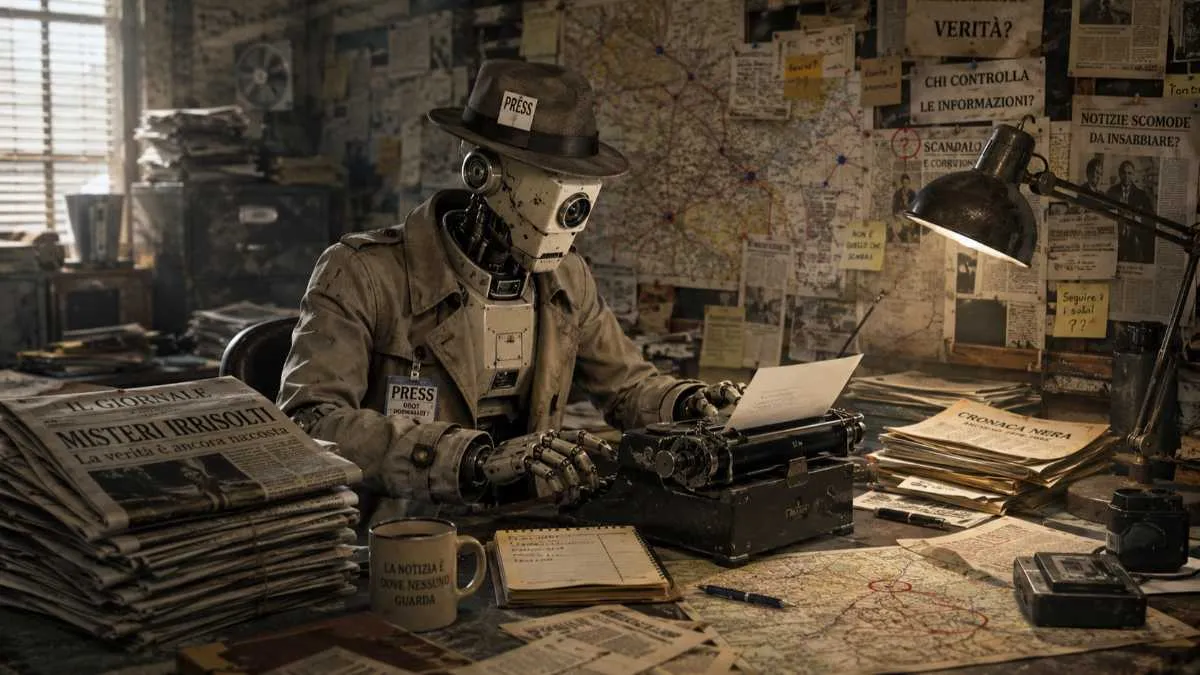
There is a fairly simple, though not foolproof, way to spot an article written by artificial intelligence. You should not begin with the grand themes—the death of the author, the decline of humanity, the replacement of journalists with a toaster with good syntax—but with the small details. With the quirks. With the conditioned reflexes. And above all with it: the semicolon. Have you noticed that there has suddenly been a proliferation of semicolons? For years, it was a punctuation mark used by sixth-form teachers and columnists in cashmere jumpers. Then artificial intelligence arrived, and the semicolon became the Rolex of the generated sentence. It pops up everywhere.
The second clue is a penchant for conceptual pairs. “It is not just a technological challenge, but also a cultural one.” “It is not a question of demonising, but of understanding.” “The real issue at stake is not choosing between man and machine, but understanding how to coexist with the machine.” These statements are almost always true. And that is precisely the problem. Artificial intelligence excels at ‘polite truths’: reasonable, balanced statements that are impossible to dispute and therefore perfectly harmless.
The third clue is order. AI is obsessed with order. First, second, third. Five reasons, seven risks, ten opportunities. The generated article looks like a freshly cleaned kitchen: everything is in its place, but nobody has actually cooked anything. Human journalism, on the other hand, leaves crumbs behind. It has an off-beat quip, a wrong but vivid adjective, a pointless but revealing aside. AI tends to sweep away the crumbs.
The fourth indicator is the diplomatic adjective. ‘Interesting’, ‘complex’, ‘delicate’, ‘significant’. The AI almost never says: ‘This is nonsense.’ It says that ‘it raises questions’. It doesn’t say: ‘This politician has told a tall tale.’ It says that the statement ‘deserves to be put into context’. It is a very well-mannered creature.
Then there is the fifth clue: the false depth created by symmetry. “The problem is not the technology itself, but the use we make of it.” “The question is not whether work will change, but what kind of work we want to build.” These are phrases that sound important but are often mental escalators: they give the impression of going up, but you remain in the same shopping centre all the time.
And this is where things become somewhat awkward. Many of the clues used to expose AI also serve to expose us. Ordered lists? We were already using them. The ‘not only… but also’ construction? We’ve worn it out completely. The semicolon? Some have always regarded it as a form of social distinction. The artificial article unsettles us not because it writes in an alien way, but because it writes in a way that is all too similar to our worst: correct, polished, cautious, devoid of flaws.
So how do you recognise a well-written text, with or without AI? Perhaps not by the fact that it’s human, but by the fact that it takes a risk. A good text doesn’t just ask questions. It picks one and gets its hands dirty. And above all, it has a voice. Even when it gets it wrong. But the point isn’t to learn to recognise AI so we can feel superior. The point is to use AI to recognise our own laziness. If an algorithm can perfectly mimic our average editorial, perhaps the problem isn’t that the algorithm has become too good. Perhaps it’s that we, for years, have been too algorithmic. So be wary not only of texts written by artificial intelligence, but also of those written by humans as if they were artificial intelligence. Be wary of prose that is bland, unremarkable, with not a single word out of place. And, of course, be wary of this article too: whilst it pokes fun at the quirks of AI, it is using almost all of them. Semicolon included.