
Politics
The space for reformism •
Europeisti.eu takes its first steps in Milan
Italian reformism is making a fresh start at the Teatro Parenti. From Carlo Calenda to Luigi Marattin, from Pina Picierno to Mario Monti, and the gamble of building a centrist, liberal and pro-European political force
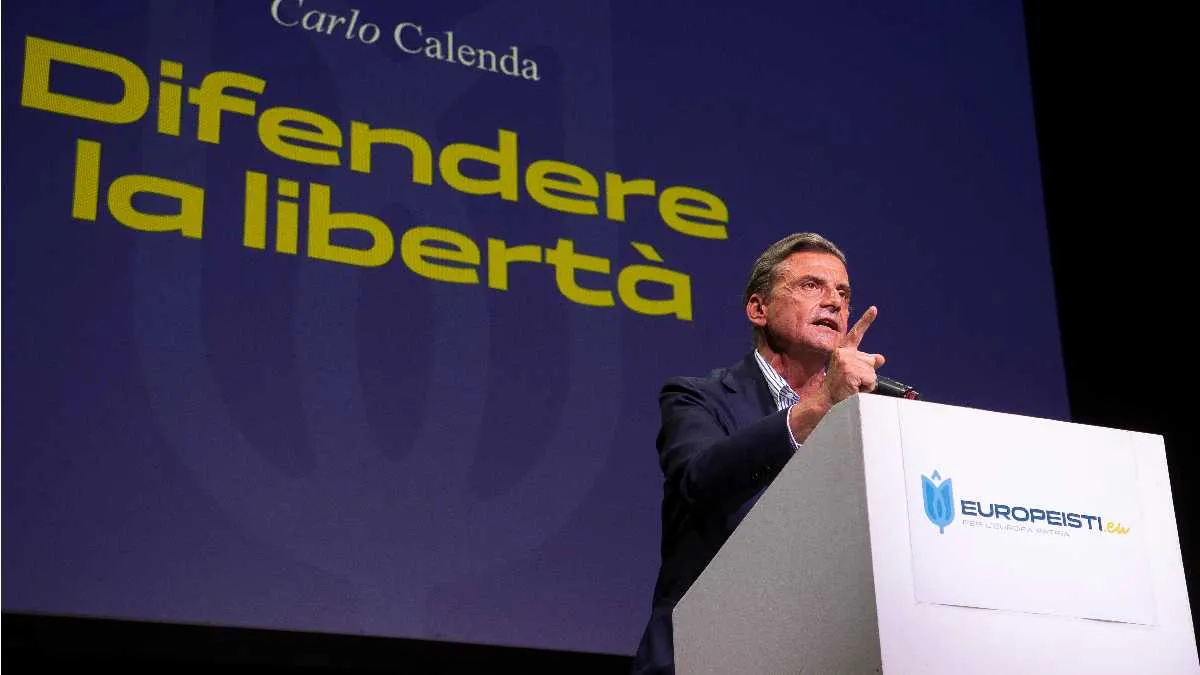
If participation is a good barometer for gauging the health of a movement, it can be said that Europeisti.eu got off to a promising start. The main hall at the Parenti proved too small; it was even difficult to find a place to stand, thanks in part to the impressive turnout that managed to bring together a significant response to the call from reformist Milan, confirming that it is a substantial force. It is no coincidence that the decision was made to launch this new political venture in a city which, in recent elections, has even given as much as 15 per cent of the vote to parties that, in various ways, identify with reformism.
A quick glance around the hall reveals faces from the middle classes: professionals, entrepreneurs, and employees from both the public and private sectors; there are few politicians, apart from representatives of the Jewish community, led by President Walker Meghnagi. There are many young people taking turns on stage, expressing a sincere belief in the united Europe they dream of for the coming years: These are the young people who founded AtenEu, a free platform for debating issues affecting young people and, of course, our continent; Forward Italia, which is active in universities; and Nova, which is building a community for the under-35s. Moving about tirelessly is Andrèe Ruth Shammah, who co-founded the theatre 54 years ago with Franco Parenti and Giovanni Testori and continues to serve as its dynamic guiding force. The enthusiasm is palpable, even if it is expressed with composure, tempered only by the realisation that building a centrist, liberal and pro-European political force is a gamble in a political system dominated by two poles that are somewhat averse to these issues.
Mario Monti makes it clear straight away that the road ahead will be difficult, indeed arduous, explaining that to build the United States of Europe – an expression repeated several times in the chamber – it will take courage, determination and a willingness to set aside any partisan interests. Just as he did in 1996 when, as a European Commissioner, he stood in the way of Italy – which had a deficit exceeding 3 per cent and was seeking admission to the single currency. Or as Kohl did when he accepted the euro and abandoned the mark because an overly strong German currency could have disrupted the nascent EU. Turning to more recent times, Gianni Vernetti highlights the differences between his camp and the other two factions accused of ‘red-brownism’: ‘In four years of war, no one from the broad coalition has ever set foot in Ukraine,’ he states forcefully, provoking a roar of approval. He then criticized the other side as well, in particular Buttafuoco, who “gave Russia a free pass in Venice”.
One of the challenges facing Europeisti.eu will be to bring together different schools of thought, as became apparent at the Parenti event. Whilst Andrea Marcucci delivered a speech in the classic liberal tradition, emphasising the value of business as a creator of wealth that can be distributed, Giuseppe De Mita countered by citing populism, which Guido De Ruggero regarded as one of the most advanced forms of liberalism. He delivered this remark to applause, with a manner of speaking and a line of argument strongly reminiscent of his uncle, who had been a pillar of the Christian Democrats. When the leaders took the floor, the policy guidelines on which to base the new political formation began to take shape: for Luigi Marattin, it must be clearly liberal in inspiration, with a state that ‘does a few things and does them well’, which ‘does not tell people whom to love, how to love them, or how a person should die’. On foreign policy, he hopes that Italy will support the existence of Israel and a Palestine free from Hamas. Then it was Calenda’s turn; he painted a bleak picture of Europe crushed by the giants – the United States and China – and at risk of becoming a colony: everything hinges on Ukraine – so argues the leader of Azione – if the Russians prevail in the Donbass, it will be like in 1939 when Hitler occupied Czechoslovakia. The reformist and liberal centre therefore becomes essential in helping to forge a European identity, which is still weak in our country.
As for strategies, it is still too early to discuss them. According to Marattin, decisions can only be made in the autumn because the outlook will be clearer by then; in Milan, the timeframe is certainly tighter as the local council elections are due next spring: Among the event’s organisers were Azione councillor Daniele Nahum, who has long advocated the formation of a third political force, and Sergio Scalpelli, who has been behind all attempts to revive reformism over the last thirty years. Carlo Cottarelli’s name was put forward as a potential standard-bearer, but he sidestepped the question. It cannot be ruled out that this time the two-party system might be called into question, even if, judging by Parenti’s remarks, the real spectre is not so much finding the most appropriate political formulas. While Monti emphasized that, in order to build Europe, personal agendas must be set aside, Ilaria Borletti Buotoni was more direct; mindful of past failures, she made a heartfelt appeal: “Let’s not argue”.