
Roma Capoccia
From ‘Welcome to Favelas. Rome, a hub for citizen journalism’
A new media ecosystem is emerging in the capital, where social media pages and influencers are highlighting urban discontent more than traditional media. Citizen journalism is taking centre stage and politics is adapting to the viral language of these platforms
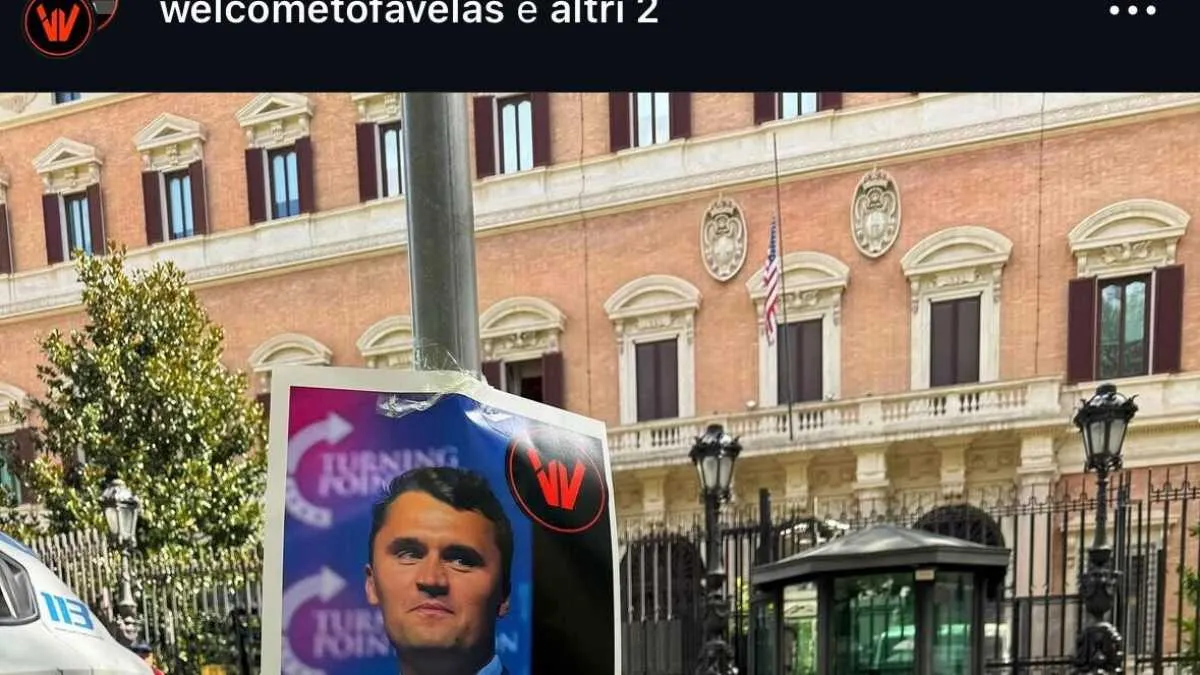
Photo taken from the Instagram profile of the "Welcome to favelas" page
Thomas Carlyle regarded newspaper editors as powerful as the rulers of the world, endowed with unrivalled powers of persuasion. Much has changed since then: the digital revolution, the exponential growth of social media platforms and the emergence of content creators and influencers have, acting in concert, thrown the traditional news system into crisis: ever-increasing waves of public mistrust, ever-dwindling readership and viewership, the so-called ‘disintermediation’ – which is in fact re-intermediation, given that true disintermediation is nothing but a glittering myth – and the waning authority of the once-venerated mass media have made way for what Elon Musk has identified as ‘citizen journalism’. Digital media, moreover, tickles narcissistic instincts, serving as an ontological showcase in which one commodifies and deifies oneself at the same time; and the idea of being able to become the vehicle of the news ourselves – before and better than the stale media outlets, before the news programmes, the newspapers, and even the most established websites – is almost erotic, dizzying. And given that communication and politics are inseparable, it is no surprise that politicians are paying increasing attention to content creators and social media: politicians themselves, after all, often adopt stylistic and content-related approaches that are indistinguishable from those of a content creator.
Rome, after all, has a mayor who has now established himself as a successful TikToker – more of a character than a political communicator: little skits, sketches, viral content turned into memes, and a thousand discussions, debates and comments, alongside eternalised and decontextualised frames that have now turned Roberto Gualtieri into a holographic figure intent on pointing out building sites, views, ruins and the River Tiber (which he wants to make suitable for swimming). The politician-content creator is an extension of the content creator-journalist, just as the entire world of communication is being swallowed up by the dynamics of the digital age and the ‘platformisation’ of reality. This idea that anyone can now be a communicator and, indeed, a public figure – celebrated by Musk’s motto ‘you are the media now’ – harbours the essence of an accelerated, spectacle-driven form of journalism, in which there is apparently no longer any distinction between those who present the news and those who receive it. It is therefore no surprise that Gioventù Nazionale, the youth wing of Fratelli d’Italia, invited Massimiliano Zossolo – founder of ‘Welcome to Favelas’, a digital platform that has evolved from a showcase of urban atrocities into a citizen-journalism initiative – to speak at Fenix, the festival held at the Laghetto dell’Eur, on the topics of extreme suburbs and social deprivation.
It is no coincidence that Zossolo is said to have met with emissaries of Elon Musk months ago, as part of an overarching project to establish a decentralised, real-time information network. Nor is it a coincidence that the ‘Welcome to Favelas’ logo is now appearing with increasing frequency in traditional publications, which are reusing some of the events featured on the page for their own articles. A sort of informal press agency towards which a continuous stream of photos and videos flows, and in whose maelstrom every aspect of existence is ground down, with reporters being ordinary citizens grappling with the exceptional nature – real or imagined – of life. Also present at Fenix will be Emanuel Cosmin Stoica, an influencer on disability issues. The trend is very clear. After all, back in 2021, in the midst of the Rome election campaign, we advised – half-jokingly – the then candidates to go and tour the ‘criminal neighbourhoods’ in the company of Simone Cicalone. Now it is Cicalone who drags the politicians along with him. On the metro. To forgotten neighbourhoods. Through underpasses and Roma camps. A successful format, to which city councillors, municipal administrators and MPs have rightly lent their support, drawn into this urban safari through lawlessness and decay. Cicalone himself was a guest at Atreju in 2024. Other influencers specialising in related issues appear on local television and are finding an increasingly prominent voice in public debate. It is not difficult to foresee how much influence these figures and this style of communication will have in the upcoming Rome city council elections in 2027.