
Sections
The portrait of Corrias •
I have added a second line
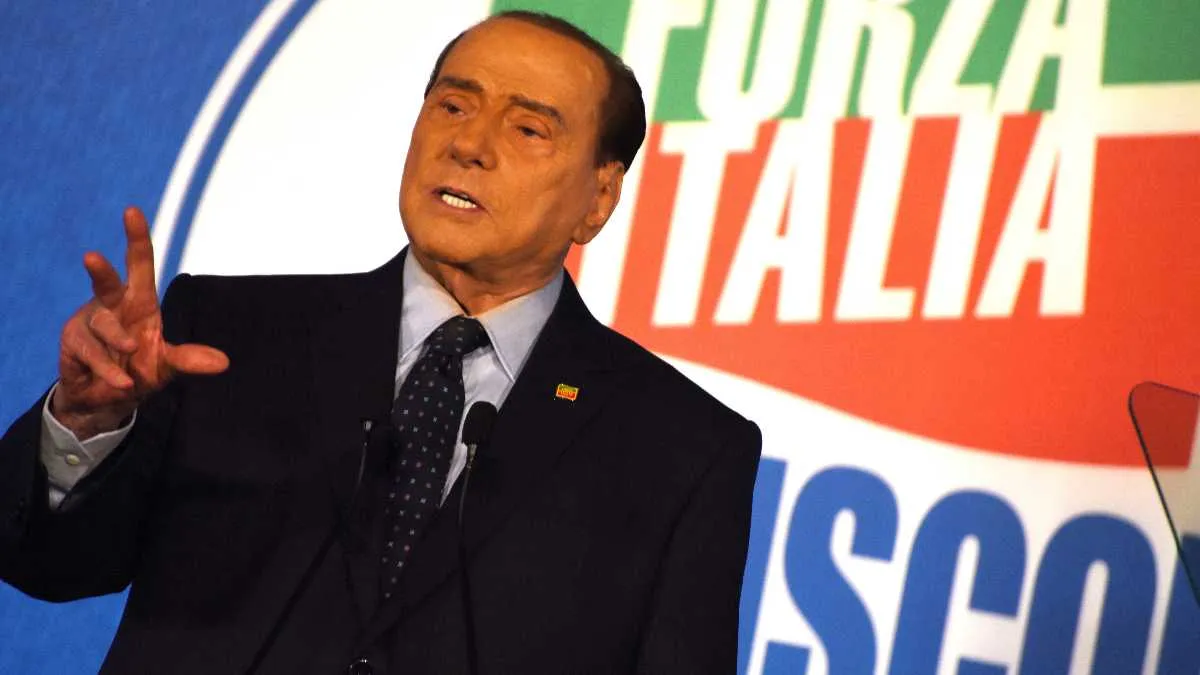
I had, of course, imagined that Corrias’s book would be ruthless towards Il Cavaliere, but not to this extent. It paints the picture of a full-time maverick. He spares nothing in his portrayal of a figure who has nonetheless shaken up the Italian political landscape in recent times.
Pino Corrias is one of *Il Fatto*’s leading columnists, although I would describe
Pino Corrias is one of *Il Fatto*’s leading columnists
him as a writer of substance and a commentator even before – and even more so than – a journalist. When I received his recent book—Berlusconi Files (Paper First, 2026)—intended to assess and recount the figure of Berlusconi, I could not help but begin reading it immediately. I had, of course, anticipated that it would be critical of Berlusconi, but not to this extent. It is the portrait of a full-time rogue. He spares nothing—as is his right—of a figure who has nonetheless turned the recent Italian political landscape on its head. It is as though he were to punch the subject of his account in the face and leave him lying there on the ground to rot.
Here are the conclusions of this book: “Over twenty years, [Berlusconi] enjoyed overwhelming parliamentary majorities, as well as unrivalled media, economic, social and cultural power. He could have introduced and scrapped reforms to improve the lives of Italians, but he thought only of his own. He could have transformed the labor market through investment in innovation, the tax system through stricter controls, and bureaucracy through simplification. He preferred not to undermine the power of large corporations or the profits of smaller ones. He did not tackle tax evasion; on the contrary, he justified it as a ‘natural right’ against the state as a tax collector. He did not clear the bureaucratic bottlenecks, nor did he curtail his own power and privileges. He could have expanded civil rights—at least in a liberal sense—but he preferred to bow to the worst elements of the Church and look after his own interests.”
I am uncertain which contemporary Italian political leader Corrias has in mind when he levels these criticisms at Berlusconi—that is, which Italian leader has done what he would have liked Berlusconi to do. If such a leader existed, I would immediately throw myself at his feet. Except that politics is not the realm of absolutes, but rather the vast spectrum of shades in between. In Berlusconi’s case, one of those intermediate shades is having been the first to empower private television stations, on whose messages every single paragraph of today’s political debate is based. As is having broken the traditional, rigid right-left dichotomy of Italian politics, thereby reshuffling the deck. I must also take into account – and my friend Corrias will forgive me for this – the fact that on every occasion I have had personal contact with Berlusconi, he has been utterly charming. I should make it clear that I am not a die-hard Berlusconi supporter: I have never voted for his party. I have not forgotten, however, that the socialist Bettino Craxi was close to him – a man for whom I most certainly did vote. And the fact that Craxi was a leading figure in Italian political life is far more than just a footnote. It is the most remarkable fact in Italian history over the last half-century. A history from which you can take whatever you like – what you like and what you don’t like – but in which you will always find Berlusconi playing a leading role. ‘Because he was the richest of them all,’ you might say. Only a fool could deny that. Money that he did not always use as a priest would have done in his place. I do not deny this either, even though I do not think Italian politics has exactly been overflowing with priests in recent decades. So much so that on the occasion when Craxi asked aloud in the Chamber of Deputies whether there were any priests amongst the men who made their living from politics and who were listening to him, not a single one stood up to say ‘present’.
And speaking of funds that once existed but are no longer available, the Italian Communist Party (PCI) no longer exists either, and the premises that housed its many local branches have closed down, including the one near Campo dei Fiori, not far from my home, where I would always enter with quiet respect as if it were a sacred place—an adjective that has no place in politics.