
Sport
World Dog Championships •
What do World Cup merchandise sales tell us about American society?
Just like during the 1994 World Cup, Americans are snapping up beer can holders. Unlike 32 years ago, however, baby bibs have disappeared from the market and there are loads of dog T-shirts on sale
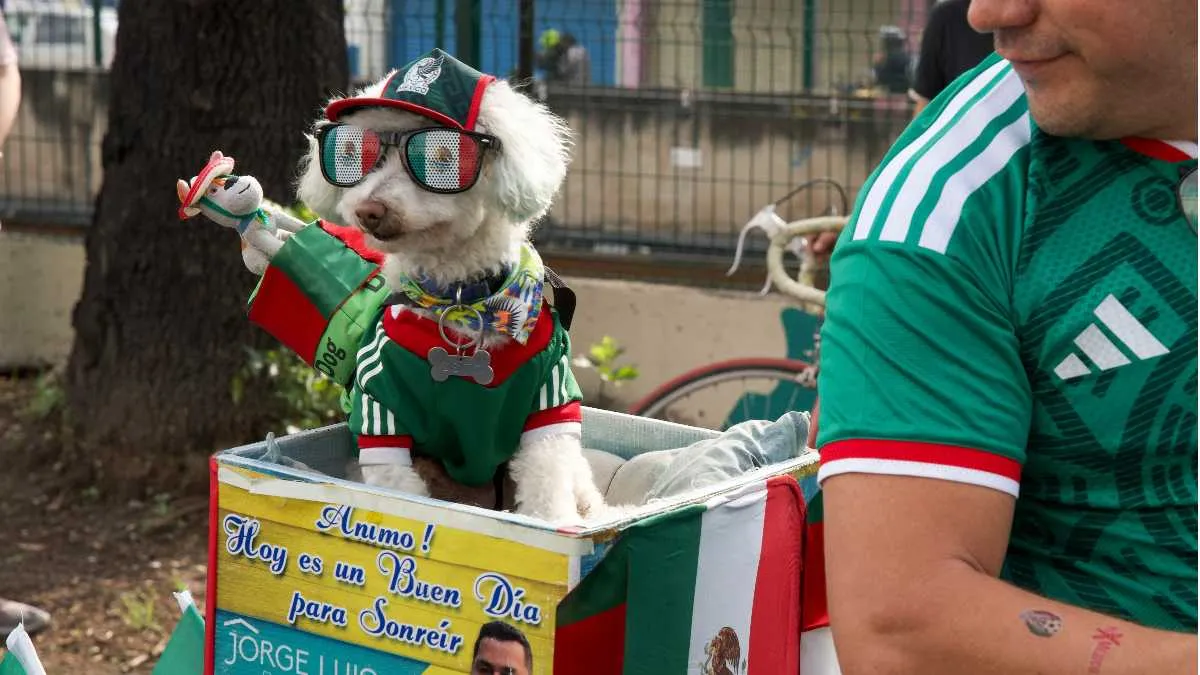
Photo: AP, via LaPresse
In 1994 in America, there were three World Cup-themed merchandise items that proved most popular with fans: the Budweiser insulated can holder shaped like the tournament’s official match ball, the Adidas Questra model; the children’s bib featuring the USA ’94 mascot, Striker – available in both the traditional version and one featuring the shirts of other national teams – and the football-shaped bowler hat. All three sold out within a matter of weeks.
Thirty-two years on, Miller’s insulated can holder – roughly one and a half times the size of a regulation football and capable of holding 12 cans – has confirmed that Americans still enjoy football when accompanied by tins of beer. And never mind that, in the meantime, annual per capita consumption has fallen from 94 to 75 litres. Consumption tends to rise during the World Cup; it has always been so. The unofficial gadget sold out within days, thanks in part to its affordable price ($20) and the limited-time online offers “while stocks last”, each of which lasted only a few tens of seconds.
Whilst headwear in America has been losing market share for decades – with the exception of baseball caps, which Americans still favour (thanks to, or in spite of, Donald Trump’s constant flaunting of them) – to the extent that the only merchandise for the 2026 World Cup, whether official or not, is in fact baseball caps, what has changed over these thirty-two years is the disappearance of bibs. They are nowhere to be found in the official merchandise or in that linked to the tournament’s main sponsors. On the other hand, banking on bibs would have been a gamble in a country – the United States of America – which, in 2025, recorded an all-time low in births, at 3.6 million, according to data from the Centres for Disease Control and Prevention. For children, what remains are soft toys, baby onesies – which are selling very poorly – and colourful water bottles, because even the United States is beginning to realise that plastic is a major problem.
Whilst children’s gadgets have either disappeared or are not very popular, dog outfits are doing a roaring trade. The dog outfits, ranging from XS to XXL, which Adidas has produced by scaling down the official kits of Argentina, Colombia, Mexico and the United States, have almost all sold out (there are still a few left of Messi’s national team kit). The vast majority have been sold in the States.
In America, the pet care market is constantly growing and reached $155 billion in 2025 (and is estimated to reach $166 billion in 2026), with around 60 per cent of this linked to dogs. This rise in spending exceeds the rate of inflation and is not even due to an increase in the number of pets in the country, which has remained virtually stable in recent years. What is rising dramatically is the proportion spent on pet accessories and gadgets, which now accounts for around 26 per cent of the total cost of keeping a dog. As for cats, this proportion has fluctuated between 3 and 5 per cent for years.
