
World
everyone is seeking it. •
Al Sharaa says no to Trump: a war with Hezbollah is unfeasible
Whilst awaiting confirmation of his invitation to attend the G7 as a guest, the Syrian president has conveyed a message to the United States: Syria remains too fragile to become embroiled in a new conflict.
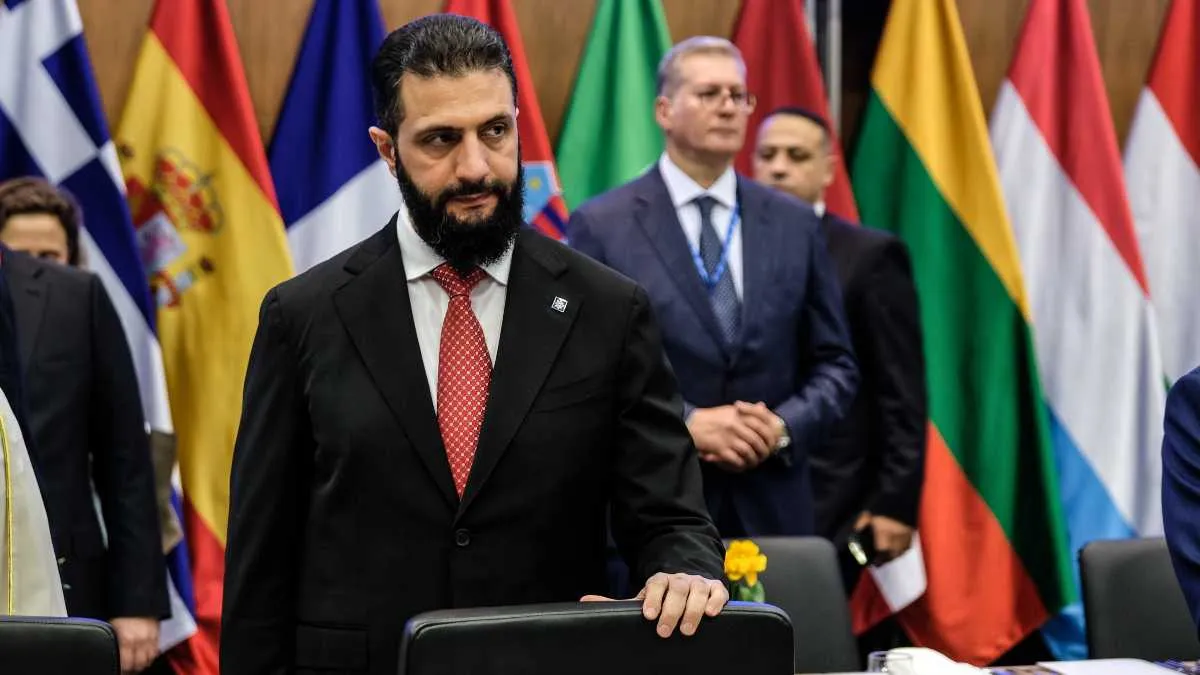
Invited to Washington by Donald Trump, invited to Évian-les-Bains as a guest of the G7, invited to Ankara on 6 and 7 July for the NATO summit. Everyone is vying for Ahmed al Sharaa’s participation, yet he is playing for time. His schedule is still being finalised, but if he were indeed to accept Emmanuel Macron’s invitation and fly to Évian, he would become the first Syrian president to attend the meeting of the world’s seven major powers. It remains to be seen whether sitting at the same table as the world’s leading figures will make him forget the turmoil currently unfolding in Syria, in places that are certainly not nearly as pleasant.
In Idlib, as in Jableh and Latakia, in Deir Ezzour as in Tal Rifaat and other outlying areas, the hunt for Assad loyalists has resumed. In the dock are not only the loyalists, but also al-Sharaa’s government, guilty of having allowed them to go free. Many of these individuals were well-known figures to the authorities, who nevertheless chose to turn a blind eye in the interests of maintaining stability. Justice, in this long and painful transition phase, remains al Sharaa’s most exposed wound. Residents in eastern Deir Ezzour are asking how Nawaf al Basheer, leader of the al Baqqarah tribe and a supporter of the Assad regime and its ally Iran, managed to return home safely, as evidenced by a photograph showing him smiling on a sofa alongside his wife and daughter. How is it that a former commander of Assad’s troops, such as Turki al Bohamad from Raqqa, who was arrested just a month ago, has been released?
The response for Syrians is a manhunt. On the coast, once the undisputed stronghold of the Alawite regime, leaflets are being distributed bearing the message: ‘Final warning. Leave or stay indoors. The revolutionaries of 2011 are coming to settle the score’. Beside it is a drawing of a bunch of bananas, a reference to the ‘banana brigades’ made up of volunteers who take the law into their own hands against loyalists. ‘Many shabiha have already slipped on banana skins,’ is the macabre joke circulating on social media to suggest that many Assad supporters have already been killed. “If you suspect anyone, report them through the appropriate channels,” was the appeal issued yesterday by the government in an attempt to calm tensions. A mockery, according to the early revolutionaries and the relatives of the regime’s victims who seek revenge, even before justice.
The dilemma of what to do with former Assad loyalists is intertwined with the international balance of power and, above all, with relations with Lebanon – and with Hezbollah in particular. For some time now, Trump has been pressing al-Sharaa to open a second front against the terrorists in Lebanon. The Syrian leader, who owes so much to the Americans, has always opposed this. The reasons are obvious. The first is that, for a fledgling army, embarking on a war against Hezbollah is a gamble in terms of the balance of power. The second, more serious than the first, is that the anger smouldering in Syria against the regime’s loyalists would erupt into a new civil war if al-Sharaa were indeed to attack Hezbollah, already a sponsor and ally of Assad.
Thus, Trump’s invitation was returned, as was the invitation to visit Washington. Last week, the Israeli press had reported that al-Sharaa was due to travel to the White House on Sunday—it would have been his second visit since 2024—and the information had been confirmed by the Syrian president’s Washington-based entourage. The precise sequence of events remains unclear, but al-Sharaa ultimately did not travel to the United States. Should he also choose to skip the G7 summit in Évian, the meeting between the Syrian president and Trump would take place in early July, coinciding with the NATO summit in Ankara—another historic invitation for al-Sharaa, sponsored by Turkey’s ally Recep Tayyip Erdogan. The same Erdogan who, according to rumours, is said to have tried to explain to Trump that the situation in Syria is still too precarious to ask it to go to war against Hezbollah.
For al Sharaa, the “new moderate,” war is not a viable option, not even against his most bitter enemies. Yesterday, in a speech in Damascus, he cited the case of the Sheb’a Farms, a patch of land measuring a few dozen square kilometres wedged between Israel, Lebanon and Syria. Since 1967, the Israelis have occupied this territory, which has always been claimed by Hezbollah, with Assad’s approval. Now, for the first time, al Sharaa has stated that Sheb’a is Syrian. “But if we were to enter into a debate on borders now, other disputes would arise, opening the door to further conflicts. A calmer political climate is needed. There are people spreading rumours of a Syrian intervention in Lebanon. These rumours are inaccurate.” A message to his friend Donald.
More on these topics

Sono nato a Latina nel 1985. Sangue siciliano. Per dimenticare Littoria sono fuggito a Venezia per giocare a fare il marinaio alla scuola militare "Morosini". Laurea in Scienze internazionali e diplomatiche a Gorizia. Ho vissuto a Damasco per studiare arabo. Nel 2012 sono andato in Egitto e ho iniziato a scrivere di Medio Oriente e immigrazione come freelance. Dal 2014 lavoro al Foglio.